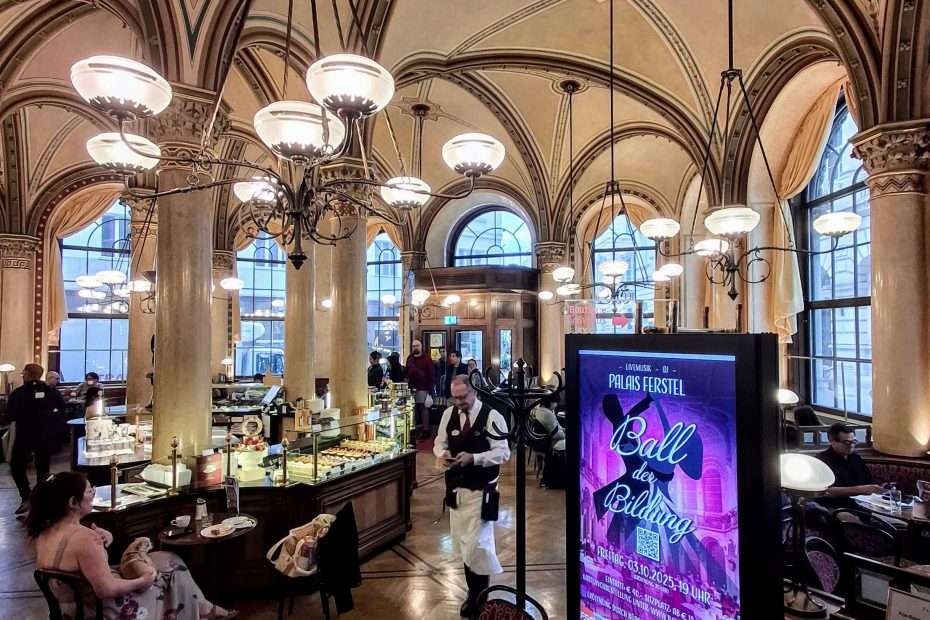
When I think of Vienna, I think of ballets, operas, and quintessential cafes in royal settings. Building my own vienna cafe guide quickly became a top priority because while I love history and cake, I am easily turned off by massive crowds and long queues.
I did plenty of research on the local cafe and patisserie scene before arriving. Many of the places on my radar are undeniably highly touristy—which doesn’t bother me at all—but I am easily turned off by massive crowds and long queues. To avoid the midday rush, I strategically planned a “cafe round” of early mornings and perfect mid-day breaks. Here is how my tour played out.
The Best Historic Vienna Coffee Houses to Visit
🎼 Cafe Mozart

Located on Albertinaplatz, Cafe Mozart oozes old-world charm. With a name like that, how could it not? I had just booked tickets for the ballet performance of Giselle—which I was incredibly elated about—and wanted something light to eat beforehand. Positioned directly across from the Wiener Staatsoper, it was an incredibly convenient choice. It was a lovely September evening, so I chose a table outside. They have a brilliant selection of cakes, and I settled on the Strawberry Pistachio cake. To pair with the sponge layers, I decided to celebrate the upcoming ballet with a glass of sparkling wine instead of coffee. A bit of a strange concoction for an early evening meal, sure, but I love following whatever mood sets me!
- History Note: Standing on a site steeped in history since 1794, the cafe was officially renamed Café Mozart in 1929 to match the nearby monument. In 1836, it made history by opening Vienna’s very first Schanigarten (an outdoor seating area on public pavement). It also holds a legendary spot in pop culture: author Graham Greene spent his days here writing the screenplay for the classic noir film The Third Man.
🏛️ Cafe Central
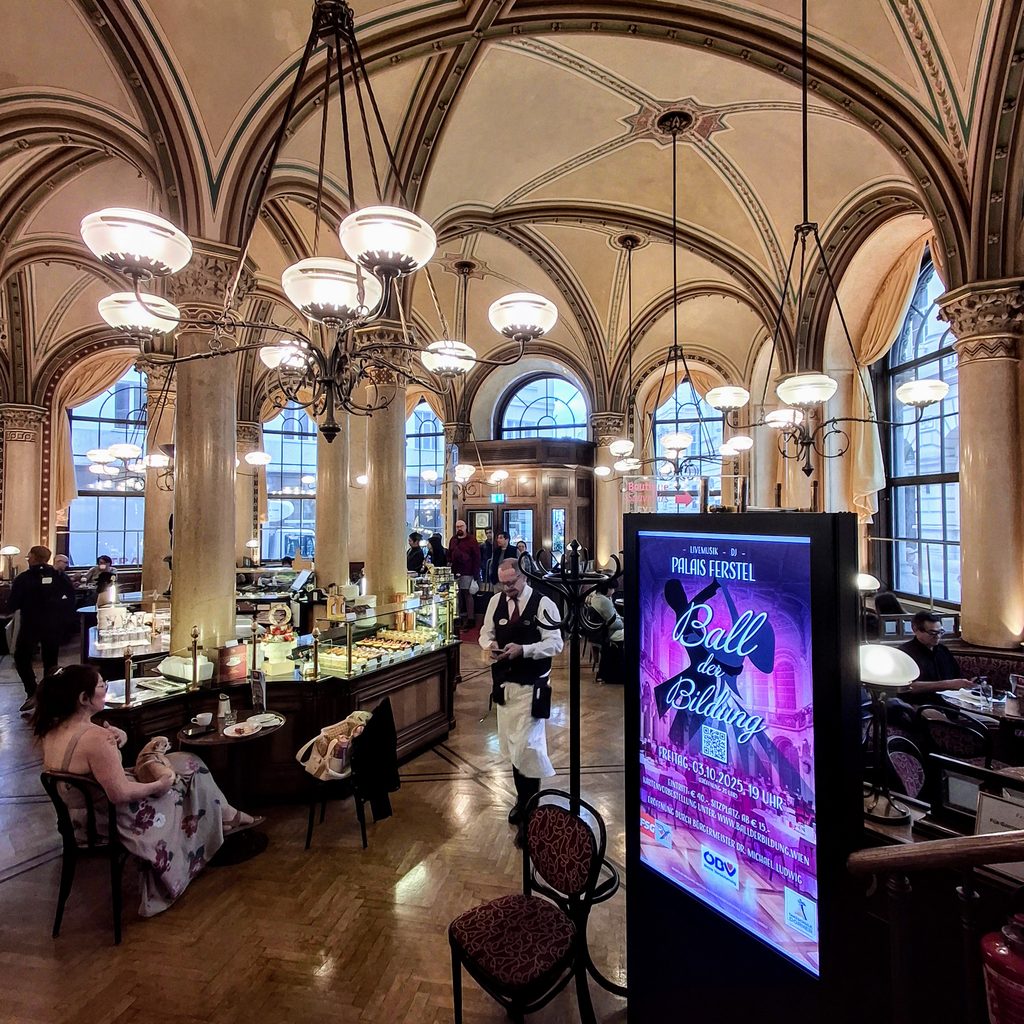


This cafe at Palais Ferstel is perhaps the prettiest, most atmospheric spot in the city, boasting incredible golden ochre coloured vaulted ceilings. It also has some of the longest opening hours, running from 08:00 to 22:00 on weekdays (and starting at 10:00 on weekends). Because it’s a massive tourist favourite, I strategically came here right at opening for breakfast. Arriving a few minutes before 08:00, I found a few fellow early birds already waiting at the door. Thanks to my timing, a friendly waiter let me pick whichever table I wanted. I ordered a hearty breakfast to fuel a full day of exploring and purely basked in the grand and elegant architecture.
- History Note: Café Central opened in 1876 and quickly became the epicentre of Viennese intellectual life. It was famously dubbed the “Chess School” because the period’s greatest minds used the upper floor for matches. In a wild twist of history, regular patrons around January 1913 included Sigmund Freud, Leon Trotsky, Josip Broz Tito, and Joseph Stalin—all living in the city and sipping coffee under this very same roof.
(Note: The cafe is temporarily closed for renovations from March 16, 2026, with a reopening planned for late 2026).
👑 Gerstner (Gerstner K. u. K. Hofzuckerbäcker)


This is another breathtakingly beautiful location, but it was surprisingly less crowded. The ground floor houses a gorgeous patisserie shop, while the first and second floors open up into classical, living-room-style spaces curated with traditional furniture and heavy, floor-to-ceiling curtains. The grandest area is the second floor, which features exquisite sunken ceiling moulding’s. I could easily picture Empress Sisi giving me a subtle nod from across the room. Wanting a slightly cosier, homey vibe, I walked back down the charcoal wall spiral staircase flanked by large portraits of Emperor Franz Joseph I and Empress Sisi. I snagged a corner seat to people-watch while enjoying an Einspänner—a strong double espresso topped with a thick layer of cold, lightly sweetened whipped cream.
- History Note: Founded in 1847, Gerstner earned the elite title of K. u. K. Hofzuckerbäcker (Confectioner to the Imperial and Royal Court). They were so highly regarded by the monarchy that they provided catering for the Imperial Pavilion at the 1873 World Exhibition and have managed the culinary services for the Vienna State Opera since it opened in 1869.
🎂 Sacher Cafe


Hands down, this is the most famous and crowded cafe in Vienna, largely fuelled by the hotel’s claim of inventing the world-famous chocolate cake. During the day, the queues outside on the street are intimidating. I almost skipped it entirely, but noticed they open very early in the morning. I thought, why not have a Sachertorte breakfast? It worked flawlessly. Arriving just before 08:00, I found plenty of free tables. The interior design screams burgundy red velvet and crystal chandeliers—vibrant, loud, but undeniably elegant. While taste is subjective, I have to admit the cake wasn’t quite my style. I prefer light, fluffy icing cakes, and the original version was a bit too dense and dry for my liking.
- History Note: The legendary Sachertorte was invented in 1832 by a 16-year-old apprentice chef named Franz Sacher, who threw it together to save the day when the head chef fell ill before a dinner for Prince Metternich. His son, Eduard Sacher, later opened the iconic Hotel Sacher in 1876, creating a permanent home for the trademarked dessert and sparking a decade-long legal battle with Demel over who owned the “original” title.
🎱 Cafe Sperl


Situated near the bustling Naschmarkt area, Cafe Sperl has a wonderfully down-to-earth atmosphere wrapped in an elegant, historic frame. It genuinely feels like a community hub where people from all walks of life gather. With a massive assortment of newspapers and classic billiard tables, it practically begs you to stay for hours. It has that cosy, neighbourhood vibe where locals pop in before or after work or sit down for a family lunch. Instead of a menu, the cakes are rolled around the room on a trolley for you to look at and choose from. I ordered tea paired with a Salzburger Topfenschnitte (a rich curd-cheese pastry) dusted heavily with powdered sugar. Watching the rain fall outside from the warmth of this highly authentic, local-heavy spot was an absolute highlight.
- History Note: Opened in 1880, Café Sperl is preserved so perfectly that it is listed on the Austrian Register of Historic Places. It was the legendary meeting ground for the Vienna Secession art movement, hosting avaunt-garde creatives like Gustav Klimt. Film buffs will also recognize its distinct pre-war interior from the iconic “phone booth” scene in Ethan Hawke and Julie Delpy’s romance film, Before Sunrise.
💼 Cafe Schwarzenberg


Where Cafe Sperl feels like a casual neighbourhood living room, Cafe Schwarzenberg shifts into an elevated, professional gear. Located on the grand Ringstraße boulevard, it trades obvious tourist crowds for white-collar professionals having business meetings and elderly locals quietly reading the morning papers over a cuppa. The preserved interior is structured, elegant, and exceptionally calm, even featuring a refined Jazz brunch. I came here for a late breakfast and ordered a traditional omelette with bacon. Sitting at a perfect table flush against the wall, I looked out over the dining room framed beautifully by arched windows and half-parted curtains. It was an incredibly sophisticated, peaceful breakfast, although I could clearly overhear the two gentlemen talking about business and life in Vienna as an expat, one with an accent I am quite familiar with.
- History Note: Opened in 1861, Café Schwarzenberg holds the title of the oldest active cafe on the Ringstraße. It was the ultimate creative sanctuary for the master architect Josef Hoffmann, a co-founder of the influential Wiener Werkstätte design movement, who sketched many of his revolutionary architectural designs right at these tables.
🥞 Demel


When it comes to pure popularity, Demel stands shoulder-to-shoulder with Cafe Sacher and Cafe Central. It features a stunning outdoor terrace and a beautiful upper-floor salon, but finding a table during peak hours is almost impossible. The ground floor showcases an open viewing bakery, a bar, and a shop filled with spectacular patisseries and candied violets in gorgeous packaging. Refusing to wait in a massive line, I took advantage of their street-side to-go window. I ordered Demel’s most famous snack: Kaiserschmarrn—a wonderfully fluffy, shredded Austrian pancake dusted with powdered sugar and served with sweet plum or strawberry jam. Eating it fresh on the go was absolutely brilliant and incredibly delicious!
- History Note: Founded in 1786, Demel is one of Vienna’s oldest confectioneries and was a beloved favourite of Emperor Franz Joseph I. Empress Sisi was notoriously obsessed with their candied violets and violet sorbet, which the shop’s apprentices used to hand-deliver through an underground passage straight into the Hofburg Imperial Palace.
💗 Aida


Aida represents the modern, commercialised face of Viennese cafe culture. This franchise chain is practically everywhere, instantly recognisable by its vibrant, retro-1950s pink branding. While they have locations across the city, the two best spots for travellers are on Singerstraße and Opernring. The Singerstraße branch features an upper floor with fantastic windows looking directly out at Stephansplatz and the St. Stephen’s Cathedral. Meanwhile, the Opernring branch sits directly across from the Vienna State Opera, providing an unmatched, budget-friendly vantage point of the historic building.
- History Note: Established in 1913, AÏDA completely modernised Viennese coffee culture. In 1946, they installed Austria’s very first Italian-style espresso machine, popularising the concept of “fast coffee and cake”. Following WWII, their ovens famously kept running by baking thousands of American-style donuts specifically for the allied troops stationed in occupied Vienna.
My Top 3 Best Cafes in Vienna: The Verdict
I genuinely found something to love in every single one of these spaces, whether for the architecture, the pastries, or the sheer history. However, if I have to narrow it down to the absolute best experiences, my top three personal favourites have to be Cafe Schwarzenberg, Cafe Central, and Gerstner. Hopefully, this first-timer’s vienna cafe guide helps you plan the perfect crowd-free coffee route through Austria’s beautiful capital!
Check out my Vienna theater and Schnitzel experiences here: Stage Lights & Schnitzel: A Three-Genre Tour Guide to Vienna’s Theaters and Taverns
Happy Travels!
With love from Jo
Travel Period: September 2025
Vienna, Austria